Business buying guide · USA · 2026
IPTV Reseller Program USA 2026: Credits, Costs and Terms Compared
Check current BexyTV offers ↗ Check current TereaTV offers ↗
Updated 12 October 2026. Commercial disclosure: TereaTV Guides promotes the reseller programmes discussed here and may benefit from visits or purchases through its links. This guide compares public offer information and provides a risk worksheet. We have not bought credits, used either dashboard, verified customer counts, audited content rights, measured provider infrastructure, or confirmed that any reseller will earn a stated amount. A public “profit potential” is an illustration, not a business result or promise. Prices and policies may change; request a current written quote before paying.
“IPTV reseller program USA” is a commercial search with a substantial commitment behind it. The buyer may be comparing starter credit packs, dashboard features, white-label options, support, and the ability to sell in a particular country. The first mistake is treating every provider's “credit” as the same unit. The second is treating advertised gross revenue as profit while ignoring payment fees, refunds, customer support, taxes, marketing, and unsold inventory. The third is selling content without confirming distribution rights for the proposed territory. This guide uses two published programmes as examples of what to verify before spending money, without pretending to have tested either business operation.
IPTV reseller program USA: the short purchase decision
The BexyTV reseller page says one credit covers one customer for one month on one device. It displayed a 50-credit pack at $200, a 100-credit pack at $300, a 200-credit pack at $500, a 500-credit pack at $1,000, and a 1,000-credit pack at $1,500 when reviewed. The TereaTV reseller page uses different wording: each credit creates one IPTV subscription, and its visible packs start at 60 credits for $180, followed by 125 for $275, 250 for $500, 500 for $875, and 1,000 for $1,400. Those page descriptions do not establish identical subscription duration, connection rights, or billing economics. Ask each seller to define exactly what one credit buys.
A first purchase should match a realistic, documented customer acquisition plan and a cash amount you can afford to hold in unused credits. The lowest per-credit price on a 1,000-credit pack is not necessarily the lowest-risk entry for someone with no paying customers. Estimate how many customer-months you can actually fulfill, when credits are consumed, how support is handled, and what happens after a refund or chargeback. If a seller cannot explain credit expiration, reversals, and territorial rights clearly, do not fill those gaps with an optimistic spreadsheet.
Both public pages describe dashboards and sub-reseller or white-label features. Those features may affect operations, but we have not verified them inside a live account. Request a demonstration, current written feature list, and contractual terms. A landing-page image of a dashboard or a promise of instant activation is not the same as a tested business process. Treat the next sections as questions to resolve, not as an endorsement of a particular pack.
IPTV reseller credit meaning: compare customer-months, not labels
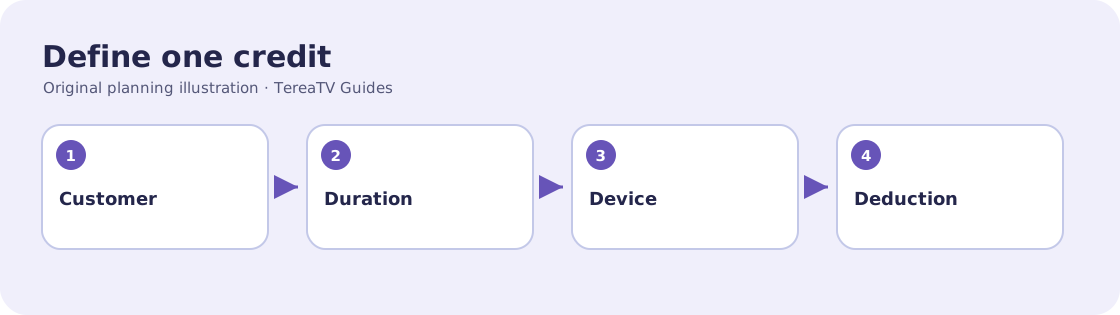
Write down the entitlement before comparing prices
A credit is an accounting unit, not a universal month
BexyTV's public wording is specific: one credit covers one customer for one month on one device. If that wording applies to the pack you buy, a 50-credit purchase could theoretically cover fifty one-month single-device units, or fewer customers over multiple months. However, you should confirm how a longer customer term consumes credits, whether extra devices require more units, and when the deduction happens. Ask for an example invoice or dashboard demonstration that shows one new account, one renewal, one extra screen, and one cancellation. A precise unit definition makes the cost model possible.
TereaTV's public page says each credit creates one IPTV subscription. It does not, in the lines reviewed, define that unit as the same one-customer-month used by BexyTV. It might involve a different duration, connection count, or conversion process; do not assume any of those possibilities as fact. Ask the reseller team to specify the entitlement created by one credit for each available retail term. If one credit creates an account with a duration that differs from a month, comparing $3 against $4 per credit is meaningless without normalizing the unit.
The essential comparison table has columns for seller, pack price, number of credits, exact entitlement per credit, time or device restrictions, what triggers consumption, and whether an unused credit expires. Only after every row is defined can you estimate the cost of fulfilling a common hypothetical customer order. Leave unknown cells blank and resolve them with the supplier. A buyer who knows the accounting unit is less likely to advertise a retail offer that costs more to fulfill than expected.
Best IPTV reseller starter pack: choose an affordable experiment
At the public card level, BexyTV's lowest visible pack was 50 credits for $200, and TereaTV's was 60 credits for $180 on the review date. A lower upfront card amount can appeal to a beginner, but it cannot settle value because the credit definitions may differ. Also consider how many active customers you can support personally, how you will obtain authorized customers, and what you will do with unused inventory if demand is slower than forecast. Starting small can protect cash even when its per-unit price is higher.
For a hypothetical scenario, suppose you have ten qualified customers who each want one month on one device. Under a verified one-customer-month model, ten units would be consumed for that first month. Add expected renewals before deciding how many credits to buy. Under a model where one credit creates a subscription with different duration or device rights, use that seller's written conversion rule instead. This example is a planning method, not a claim about the contents of either vendor's actual account or customer demand.
Before buying a pack, determine whether the seller requires business verification, a minimum order, a separate dashboard fee, or a payment method with added charges. The public TereaTV page says no setup fees; BexyTV describes no setup fees and no recurring minimums. Confirm the live terms at checkout, because a sales page can change. Ask whether you can receive a limited demonstration of provisioning and support without exposing real customer data. A practical trial of the operations is more informative than an attractive gross-margin graphic.
IPTV reseller packages compared: normalize the public numbers
BexyTV's listed pack prices imply card-level unit prices of $4 at 50 credits, $3 at 100, $2.50 at 200, $2 at 500, and $1.50 at 1,000. TereaTV's listed packs imply $3 at 60, $2.20 at 125, $2 at 250, $1.75 at 500, and $1.40 at 1,000. These are arithmetic divisions of public totals by public credit counts. They are not normalized fulfilment costs until the exact credit entitlement, permitted devices, duration, support, and any fees have been confirmed in writing. A one-dollar credit that covers less service may be more expensive per customer-month than a three-dollar credit with a different entitlement.
Check the live checkout for the pack you actually select. We noticed that BexyTV's public 200-credit card listed $500 and $2.50 per credit, while a separate calculator example on the same page displayed different numbers for a 200-credit scenario. That visible mismatch is a reason to ask for the authoritative current quote, not an accusation of how the account will bill. Do not publish a retail price based on one widget without checking the final order amount. Record the date and a private copy of the quoted terms.
Pack size affects cash at risk. A 1,000-credit pack asks for a four-figure prepayment on either public page. If you sell slowly, your effective cost of acquiring and servicing each customer may rise even if the supplier unit price falls. Model conservative, expected, and optimistic sales scenarios and include unused credits in each. A cheap per-unit quote does not return cash from customers who never materialize. Ask whether unused credits can be refunded or transferred and under what conditions; never infer that from “credits never expire” alone.
IPTV reseller margin: separate revenue, gross profit and net profit
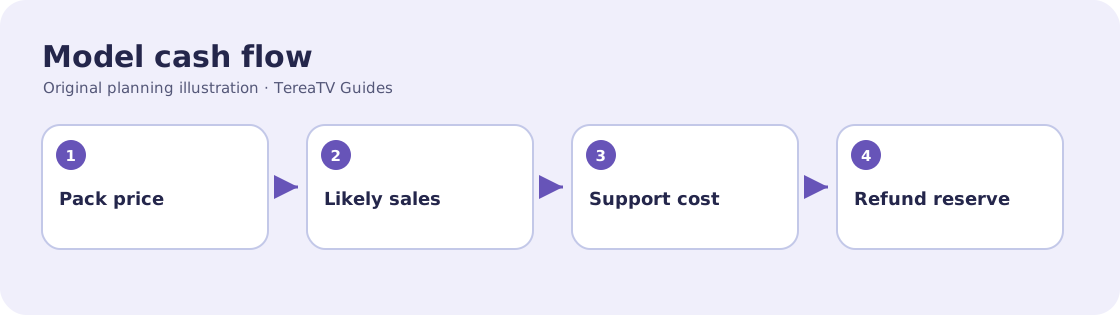
Check the denominator behind a percentage claim
Marketing pages may show dramatic “profit” or “margin” examples. Begin with definitions. Revenue is the total paid by customers. Gross profit from a credit-based sale is revenue minus the cost of the credits actually consumed, before other business costs. Net profit also accounts for payment processing, refunds, chargebacks, tax, customer acquisition, support labor, website hosting, software, legal work, and any other real operating expense. If credits sit unused, their upfront cost still ties up cash. Do not call gross revenue or a full sell-out illustration guaranteed earnings.
For a hypothetical one-customer-month sale at $15 and a confirmed $3 fulfilment unit, gross profit before other expenses would be $12. If processing and support cost $2 for that transaction, the illustrative contribution would be $10 before tax and shared overhead. If a customer disputes payment or you refund them while the provider does not restore the credit, the result changes again. This arithmetic is a worksheet example, not a prediction for any seller's network, approval rate, or customer base.
Be careful with percentage language. A markup percentage compares gross profit with cost; a gross margin percentage compares gross profit with revenue. If a unit costs $3 and sells for $15, the $12 difference is 400% of cost but 80% of revenue. Describing both as “400% margin” confuses buyers. Ask each supplier which formula its marketing example uses and reproduce the arithmetic independently. A realistic plan should show the cash you must pay now, the number of units you might sell, and the operating expenses you expect, without a fabricated promise of sales.
IPTV reseller white-label panel: inspect the actual workflow
Both sellers describe account-management dashboards and branding options. A reseller should verify the workflow end to end: receive credits, create a permitted customer account, set its term and device allowance, send setup information safely, view expiry, renew, suspend, correct an error, and obtain support. Request a demonstration using test data, not real private customer records. Ask what roles are available to staff or sub-resellers, whether activity logs can be exported, and how you would reconcile a payment with a provisioned account.
Branding terms deserve precision. A “white-label dashboard” may mean the admin interface can show your logo, while a branded end-user app may require a separate account, developer fee, review process, or larger pack. BexyTV's public page describes optional branded player apps and distinguishes co-branded and white-label arrangements in its FAQ. TereaTV advertises white-label branding on its packs. Do not treat these phrases as interchangeable. Ask whether the capability is included in the exact tier you are buying and what setup or maintenance work remains your responsibility.
Security and privacy matter when customer details enter a reseller panel. Ask what personal data is stored, who can see it, whether staff roles can be limited, how login is protected, and what happens when a sub-reseller relationship ends. Use unique account credentials and supported authentication methods. Avoid sharing a single administrator password among workers. A marketing dashboard can look polished while leaving important operational policies unclear; those policies belong in the due-diligence list before you collect any customer information.
IPTV reseller support: who answers the retail customer?
The supplier may provide technical support to you, to your end customer, or both. Those are different service models. TereaTV's page advertises 24/7 technical support and says its team can assist resellers. BexyTV describes a partner support channel during North American business hours on the reviewed page. Verify exactly who receives a ticket, in what hours and time zone, and how a retail customer is expected to contact someone after your working day. Do not promise 24/7 help under your own brand unless you know how it will actually be delivered.
Prepare a support responsibility matrix. Include account activation, payment disputes, player installation, network troubleshooting, content availability, renewal, cancellation, and refunds. Assign an owner and response path for each. Ask the provider how long an unresolved account issue can remain open and how it communicates service changes. We have not tested either company's response times, so published speed claims remain seller claims. A reseller's reputation will depend on what the customer experiences, not on the most generous number on a landing page.
Refunds and chargebacks should be discussed before the first retail sale. BexyTV's FAQ says an assigned credit is considered spent even if the reseller later refunds the end customer. Verify the current policy for the exact package and payment method. Ask TereaTV what happens to credits after an erroneous provision, refund, dispute, or early cancellation. Keep a reserve for refunds and support work rather than treating every sale as immediately distributable profit. A clear customer-facing policy should align with what the supplier will actually provide you.
IPTV reseller rights and territory: verify before selling content
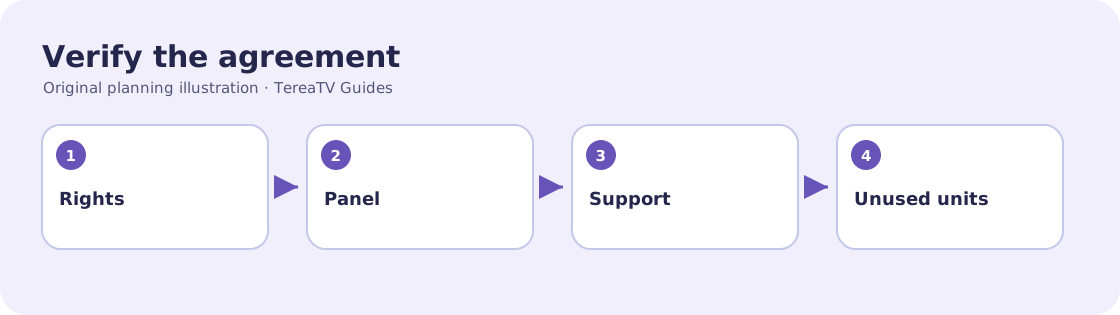
IPTV is a delivery technology; the right to distribute a particular channel or programme depends on licensing and territory. A provider's public channel count or sports image does not by itself demonstrate that a reseller may market every listed item in the United States or Canada. Before building advertisements around a named league, local station, film, or pay-per-view event, request the supplier's current rights information for the territory and the exact reseller arrangement. If the answer remains broad or unsupported, do not make the specific claim to customers.
The same principle applies to logos, screenshots, app names, and customer testimonials. Confirm which brand assets you are allowed to use and what legal disclosures must accompany them. Do not imply that a league, network, or device manufacturer endorses your business merely because its content category or hardware appears in a catalog. If you serve two countries, ask separately about each territory. A US authorization does not automatically answer a Canadian distribution question, and an international content list is not a universal permission slip.
This guide does not offer legal advice or validate either supplier's licenses. It makes rights verification a prerequisite for responsible marketing. Keep a dated record of the supplier's written answer, the territory, the named content, and the customer-facing claim you make. If the seller cannot provide an adequate answer for a material programme, omit that programme from your advertising until the issue is resolved. This may feel slower than copying a high-volume sales page, but it reduces avoidable customer disputes and misleading promises.
IPTV reseller customer acquisition: budget for real work
Buying credits is not a customer acquisition plan. List how a buyer will discover your service, what useful information you will publish, how you will answer pre-sale questions, and what the support process costs. An original comparison or setup guide can help someone make a decision, but a network of near-duplicate promotional pages and reciprocal links can create noise without building trust. Publish clear plan terms and honest limitations rather than a fabricated “tested #1” claim. Measure leads and conversions from actual analytics if you have them; do not invent them to justify a large pack.
Model at least three scenarios. In a cautious scenario, only a small fraction of the pack sells during the first months. In a base scenario, sales arrive steadily but support and refunds take time. In a strong scenario, more units sell, but the reseller may need additional staff and a better helpdesk. Calculate cash flow for each, including upfront pack payment. The lowest unit price is attractive only if you can fund and fulfil the volume. If the cautious scenario would create an unacceptable loss or cash shortage, start with a smaller order or postpone the purchase.
Keep a distinction between a reseller programme and an affiliate programme. An affiliate typically refers buyers to a seller and may earn a commission under its terms, while a reseller buys inventory or credits and handles a retail relationship. The latter can offer more control but also more operational and financial responsibility. Both suppliers have separate public business routes. If you mainly want to test audience interest before handling end-customer support, ask whether an affiliate arrangement better fits your stage; do not purchase reseller inventory merely because a page advertises high margins.
IPTV reseller agreement checklist before a credit purchase
Before accepting a quote, confirm the legal seller, company and support contact, exact credit entitlement, pack price, tax and payment fees, expiration or transfer rules, refund and chargeback treatment, territory and content rights, dashboard access, branding scope, customer-data handling, staff roles, support hours, and what happens if the programme changes or closes. Identify whether the pack creates an ongoing payment obligation or is genuinely one-time. Ask how to export records and how you can serve customers if a provider's panel is unavailable.
If API access is important, request current documentation and authentication details before promising an integration. BexyTV's public page describes a REST API and webhooks; TereaTV's page describes its dashboard and account operations. We have not tested either. A small technical proof of concept with synthetic data can clarify whether the available controls fit your billing system, but do not collect customer secrets or expose real credentials in a public demo. An integration claim should follow a working test, not precede it.
Read the actual contract or terms of service, not only the sales card. If a clause about unused credits, customer ownership, dispute resolution, or content representation is unclear, ask for written clarification. Record the version and date of the terms you accepted. Since this is a business purchase with real financial and legal consequences, consider qualified local professional advice for tax, licensing, and consumer obligations. This page is a checklist to organize due diligence, not a substitute for a contract review.
Final IPTV reseller programme comparison worksheet
Create one row per offer and compare only known facts. Write the public pack price and date checked, but leave the normalized cost per customer-month blank until each credit's entitlement is confirmed. Record the minimum cash commitment, unused-credit rule, provisioning demo result, dashboard and white-label scope, support responsibility, refund treatment, rights evidence for your territory, and expected operating costs. Mark each cell confirmed, seller claim awaiting proof, or unresolved. That makes a good sales conversation more useful than a score invented from website graphics.
For a beginner with no customers, a modest pack and clear support process may be wiser than maximizing a per-credit discount. For an established operator with documented demand, a larger pack may lower fulfilment cost, provided the credit unit and rights have been verified. Neither situation guarantees profit. The correct decision is the one that remains viable after unsold inventory, refunds, customer service, processing fees, and legal compliance are included. If the numbers only work when every credit sells immediately and no customer needs support, the model is too fragile for a confident purchase.
Review the current BexyTV reseller offer and TereaTV reseller offer directly. These are promotional links. Ask both sellers to define their credits and provide a current written quote before paying. No package should be described as “the best IPTV reseller program” for your business until the units, terms, rights, and likely customer demand have been checked under the same method.