Smart-TV buying guide · USA · 2026
Best IPTV for Smart TVs in the USA 2026: Apps, Free Trial, Screens and Total Cost
Check current offer and trial ↗
Choosing IPTV for a smart TV should start with the television already in your living room, not a seller's channel count. A service can advertise a large catalog while the app you need is absent from your TV's store, the remote is awkward, or the program you actually want is unavailable. This guide gives US households a practical purchase sequence: identify the TV platform, confirm the exact app, check viewing rights and desired programs, use a short trial deliberately, calculate the full cost, and read the cancellation terms. FreeGoTV is the promoted example in this article. That commercial relationship is disclosed up front; nothing here represents an independent playback test or a verified audit of channel rights.
The fastest answer is to write down three things before paying: your TV's brand, model, and operating system; the two or three specific programs you need; and the number of screens that might stream at the same time. Ask the seller to confirm those requirements in writing. If the answer is vague, do not substitute a generic device logo or a huge channel total for proof. If you receive a trial, test the ordinary evening routine on your own connection. Trial observations tell you about your setup at that time, not about future availability. Prices and offers change, so use the provider's live checkout for the final figure rather than treating any figure printed here as a standing quote.
Quick answer: what should a US smart-TV buyer check first?
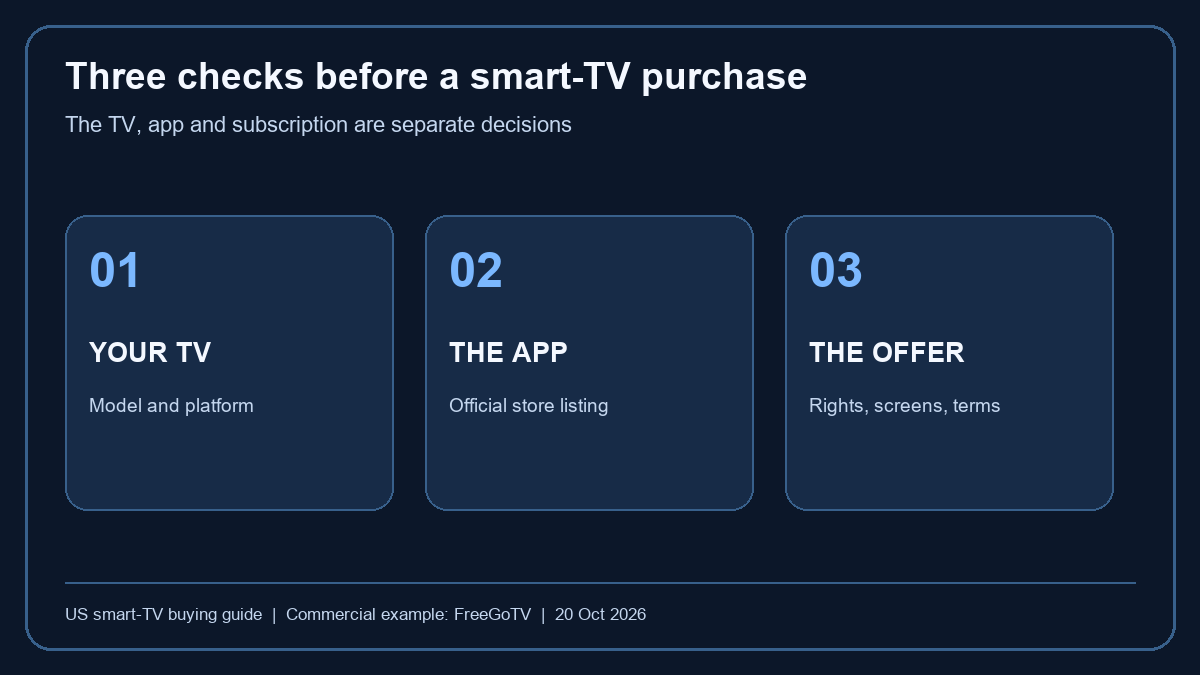
Start by separating the TV platform, the player app, and the content subscription. The TV platform is the software built into the device: for example Google TV, Samsung's TV interface, or LG webOS. The player is the app that opens a stream or account. The subscription is the paid access sold by a provider. These are three different things. Buying a subscription does not automatically install a compatible player, and installing a player does not prove a particular channel is licensed or included. This distinction prevents a surprisingly common purchase mistake: comparing monthly prices before knowing whether the household can even open the service on the intended screen.
Next, check the exact television model. Smart-TV app catalogs vary by platform, region, model year, and sometimes software version. Search the TV's own app store for the proposed app, then confirm the app name and developer rather than trusting a screenshot from a salesperson. Google explains that Google TV users can find apps from the Apps area and install an available app from its listing. LG and Samsung likewise provide model-specific support for their own app stores. Those official instructions establish how to check availability; they do not endorse any IPTV seller. Links to each support page appear near the end of this guide so you can check the method that matches your screen.
Finally, look at the purchase terms. Record trial duration, renewal price, number of simultaneous connections, support channel, refund conditions, and whether the plan requires a separate app charge. Ask whether the programs important to you are available in your region through authorized distribution. This guide deliberately avoids promising that any particular sports league, film, or channel is present. Catalogs can change and a vendor's listing is not a rights document. A complete answer to these questions is more valuable than another page of unverified superlatives.
Smart-TV IPTV compatibility: Google TV versus Samsung versus LG
On a Google TV, the simplest first check is the TV's Apps tab or search. Type the exact player name, read its listing, and note whether it is offered for that device. Google says availability may depend on the device, which is why a phone search is not a substitute for opening the TV store. If the seller supplies only an unfamiliar download link, stop and ask what officially distributed app works on your model. Installing software from an unknown source can create avoidable security and maintenance problems. A separate streaming stick may be an option if the built-in TV cannot use the desired legitimate app, but add its cost and the extra remote to your calculation before choosing it.
Samsung televisions use their own app environment rather than the Google TV store. A phrase such as “works on Android” does not establish Samsung compatibility. Open Apps on the Samsung TV, search for the app, check its details, and use Samsung's help page for the installation steps that apply to the model. An older set may have a narrower catalog than a new one. A seller might suggest screen mirroring as a fallback, but mirroring changes how you control playback and may add friction every time you watch. It is better to confirm the normal living-room flow, including how the remote opens the guide and returns to a program, before agreeing to a long subscription.
LG webOS is a third platform with its own store and settings. LG's US support explains app installation and notes that internet connection, account sign-in, service country, and available storage can affect it. Check these ordinary prerequisites before deciding an IPTV subscription is broken. The application experience may also differ between TV generations. If a seller says a service is “compatible with all smart TVs,” request the precise app and supported model information. A compatibility claim is useful only when it maps to the device you actually own. For any platform, write the model number down and keep a photo of the app listing for your purchase notes.
Which app do you need for a smart-TV IPTV subscription?
The answer depends on the provider's authorized delivery method. Some subscriptions use the provider's own app. Others ask you to use a third-party player and then enter a portal address or account credentials. A player can be merely a playback tool; its presence on a TV does not itself grant access to any content. Ask the seller to name the player, identify its official download location, state whether the player has its own fee, and explain how account details are entered. Never publish your login or a playlist address in a review, support forum, or social post. Those details may provide access to your account.
Check the everyday remote experience as carefully as the initial login. Can you move between categories without repeated typing? Does the app preserve a watchlist or recently viewed list, if that matters to you? Are closed captions available on the specific programs you need? Does the program guide display meaningful times in your local zone? How do you sign out when a television is sold, shared, or placed in a rental? These questions are not glamorous, but they determine whether a service remains convenient after the first evening. Treat any feature claim as something to verify on your own device during the trial instead of a fact inferred from a product icon.
If a TV platform lacks the suggested player, ask about a supported, legitimate alternative before buying. A device purchase can easily turn a low advertised monthly price into a more expensive choice. Do not assume a smart TV's browser will behave like a purpose-built app; a browser might be awkward with a remote or may not support a seller's chosen playback method. The safest buying sequence is platform first, app second, content third, and payment last. Reversing that order makes the household absorb the compatibility risk.
How to use a 24-hour IPTV trial on a smart TV
A short trial is useful only if you plan it. Begin by confirming the trial's start and end times and whether a payment method will be charged automatically. Then install the named app from the appropriate official store, where available. Sign in using the provider's instructions and open the exact program categories you care about. Test with the TV remote rather than relying solely on a phone. Spend part of the trial at the same time of day that the household normally watches; a midday check says little about an evening routine. Record any support question and how the seller answers it, but do not invent a response or rating if you did not receive one.
Use a simple observation sheet. Write the TV model and software version, whether the app installed from the store, whether login worked, and whether the desired program was actually offered at that moment. Note picture and audio only as an observation on your own network. If buffering appears, try an ordinary network check and a different legitimate stream before assigning blame. Wi-Fi congestion, TV firmware, internet service, app behavior, and the source stream can all affect the result. A single trial cannot guarantee future performance. It can, however, expose a clear incompatibility before you commit to a longer plan.
Before the trial expires, revisit the payment terms. A “free” trial may have eligibility rules, may require a credit card, or may convert automatically; only the current seller terms can settle that. If the provider cannot explain renewal, cancellation, or the exact app, decline the upgrade. If the trial was not enough to see the program you care about, do not infer its availability from a marketing category. Request a current program list and rights information. Keep screenshots of the offer, checkout total, and written answers, because promotional pages can change after you purchase.
Smart-TV trial checklist: seven checks before payment
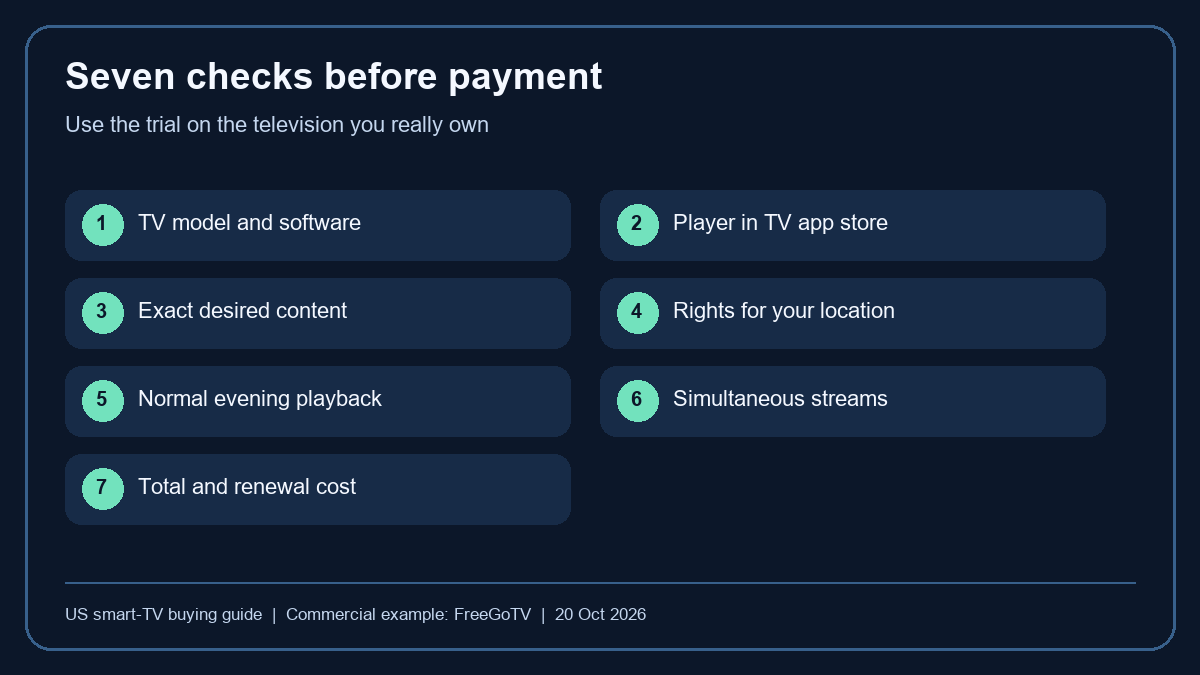
First, confirm the name and version of the TV operating system. Second, find the proposed app from the TV itself. Third, check the specific programs, not a broad genre count. Fourth, ask whether the provider has the distribution rights relevant to your location. Fifth, run the trial at the normal viewing time. Sixth, check how many screens may stream concurrently in your household. Seventh, calculate the full amount due and the renewal amount shown at checkout. These seven checks create a clear decision record without pretending to produce a laboratory score. They also make it easier to compare two offers on equal terms.
For a family, add two practical questions. Will different people want to watch different programs at the same time, and will a child use the television? A “four devices” claim might refer to installations, simultaneous streams, or something else entirely. Ask the provider which meaning applies, then test the permitted pattern if the trial allows it. Keep account credentials out of shared notes. Set up any child restrictions provided by the platform or app, and verify that those controls cover the actual player being used. A child profile on the TV may not automatically control every third-party app in the way a parent expects.
For roommates, consider whose account owns the subscription and which person can change the password or cancel renewal. For an older relative, prioritize large text, simple remote navigation, and support instructions they can follow. For a sports fan, distinguish an authorized live event from a highlights clip or a schedule listing. For film viewers, distinguish a current catalog from a title that used to be present. These scenarios turn vague “best IPTV” searches into precise purchase questions. The goal is not to crown one provider for everyone; it is to select a service that actually fits the household's devices and lawful viewing needs.
IPTV cost on a smart TV: monthly price versus annual total
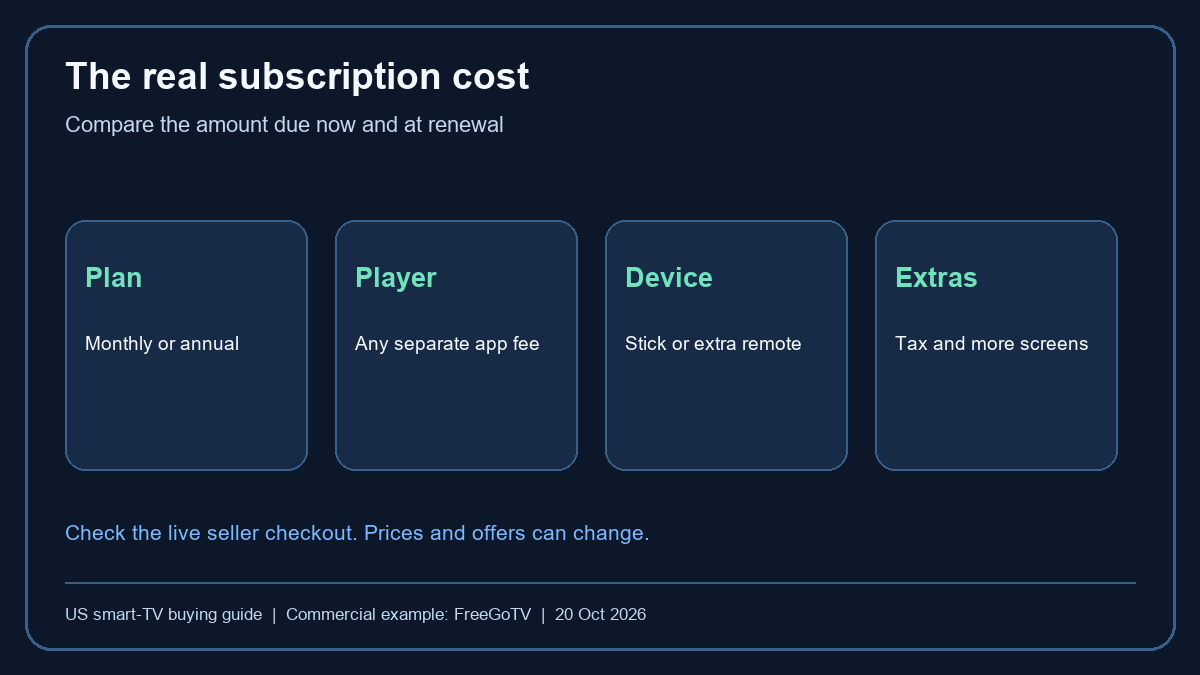
The advertised monthly price is only the starting number. Add any app fee, streaming device, tax shown at checkout, optional extra connection, and renewal terms. If you compare a monthly plan with a yearly offer, divide the yearly amount by twelve for a rough monthly equivalent, but also consider the greater commitment and refund policy. A trial that requires a full payment up front is not the same financial exposure as a no-card trial. Write down both the amount due today and the amount due at the next renewal. If a seller advertises a discount but checkout differs, use the checkout amount and ask for clarification before paying.
As a dated example, FreeGoTV's public page on 20 October 2026 displayed a 24-hour free-trial offer and a one-connection monthly plan starting at $15. Those are seller-published terms, not a guarantee that the same offer will be available when you read this. The page also presents options for more simultaneous connections. The actual price depends on the selected plan and the current checkout. If you consider that provider, begin at its official site, review the plan details, and save the final total. This guide receives a commercial benefit from promoting it, so weigh the source appropriately and compare the same facts with other authorized sellers.
Consider two simple examples without treating them as quotes. A $15 monthly plan paid for twelve months is $180 before taxes, devices, or extra app charges. A $120 yearly offer would average $10 a month if the full year is used, yet may be a poor fit if you need the service for only three months and cannot obtain a refund. Likewise, a two-screen plan may cost more than a one-screen plan but prevent conflict in a household with simultaneous viewers. The right comparison is total useful cost for your likely term, not the smallest number in the largest font. Verify the live price and cancellation method immediately before paying.
FreeGoTV as one commercial example, not a tested winner
FreeGoTV is included here because it provides a public trial and plan page that a reader can inspect directly. This is a promotional placement within our guide network. We have not independently measured its uptime, counted its channels, audited its catalog rights, or tested every smart-TV model. If its page claims a large library or broad device support, regard those as provider statements until the seller supplies detail and your own device confirms compatibility. A high channel number is not an answer to “Can I watch this authorized program on my LG TV tonight?” or “What happens if I cancel after the trial?”
Visit the current FreeGoTV site to check the trial, plan options, supported player instructions, and current checkout. Ask support for a written answer about your exact TV model and the particular content you want. If the service requires a separate player, check that player's official store listing and any additional cost. If a deal looks different from a prior screenshot, use the live seller page as the latest seller statement. Do not rely on this article as a contract or a rights certification. Our role is to explain what to verify before a US household spends money, then point to the offer for the final details.
A useful comparison sheet has five rows: device/app compatibility, exact authorized content, trial terms, simultaneous streams, and total cost plus cancellation. Place FreeGoTV and any alternative in adjacent columns. Leave a cell blank if a seller has not answered. That blank is more honest than inventing a feature. Make your decision when the critical cells are filled and the trial shows the service working for your own use case. If another service has better documentation for your required program or device, that evidence should guide the decision even if its headline price is higher.
Smart-TV IPTV troubleshooting before blaming the subscription
When a television says an app is unavailable, first confirm the TV platform and region. Google, LG, and Samsung operate different stores; an app installed on a phone or streaming stick may not appear on the built-in TV. Check the device software update through the TV maker's settings, then revisit the app store. LG's support specifically lists internet connection, account sign-in, service-country setting, and storage as possible installation blockers. These checks do not prove that the desired app will be available, but they separate a local setup issue from an unsupported platform. Keep a record of the TV model and any error message when contacting the seller or app developer.
If the app opens but a program fails, avoid immediately changing passwords or paying for a longer plan. Check whether other authorized content in the same app opens, whether the TV has a stable connection, and whether the provider reports a current outage. If a program is missing altogether, ask whether it is included and licensed for your area rather than assuming a technical fault. If the remote is slow, close unused apps and check for system updates using the TV maker's guidance. Google provides official steps for a slow Google TV device, including app and system updates. These are ordinary diagnostic steps, not evidence that a particular IPTV provider is reliable.
If the account is shared across screens, check the actual simultaneous connection limit and sign out of devices no longer used. Do not publicly post credentials or portal details while seeking help. If a payment or renewal is unclear, use the seller's documented support channel and keep receipts. Avoid deleting important account messages until cancellation is confirmed. A provider that cannot explain a basic compatibility or billing problem in writing may be a poor fit, regardless of a flashy promotional catalog. Your trial should reveal enough of this support process to inform the decision.
What makes a smart-TV IPTV purchase legitimate and practical?
The most important question is authorization. A platform's ability to play a stream does not tell you whether the seller has rights to distribute its movies, sports, or channels. Ask the provider for clear information about its rights and the territory covered. Be cautious when a seller promises every premium event and film for an implausibly small fee without explaining the source. This guide does not provide legal advice or determine the status of a particular provider. It does make rights verification part of a sensible buyer checklist, because losing access to an unlicensed catalog can leave you without the very program you bought the plan to watch.
Privacy and account security matter too. Use the official app store when the desired app is available there, keep device software current, and avoid sharing the streaming login beyond the permitted household. Check what personal information the seller requests during a trial. A one-day trial should not require you to disclose unrelated data. Use a payment method that provides a clear receipt and a way to review recurring charges. Read the renewal date and cancellation process, not just the trial badge. These habits help with any online subscription and are particularly useful when a seller uses a separate player app.
Practicality is separate from legality or price. A technically compatible service may still be difficult for the person who will use it each day. Try the remote, menu, search, caption controls, and sign-in flow. Confirm that other household members can use the TV without resetting the account. If a streaming stick is necessary, include its power cable, available HDMI port, network strength, and extra remote in the plan. The service that looks cheapest on a comparison table may cost more time and attention than a documented, convenient alternative. This is why the guide emphasizes an ordinary living-room trial instead of a claimed universal winner.
Frequently asked questions about IPTV on US smart TVs
Does every smart TV have the same IPTV apps?
No. App availability varies by operating system, region, model, and software version. Search the store on the actual television. A Google TV listing does not establish availability on Samsung or LG. If the provider recommends a player, confirm its name and store listing before paying. If the app is unavailable, a separate supported device may help, but that adds cost and complexity. Never treat a generic “smart TV supported” icon as a compatibility guarantee for a specific model.
Is an IPTV player the same as a subscription?
No. A player is software for opening content; a subscription is the access sold by a service. Some players charge separately. Ask which app the seller expects, where to obtain it officially, whether it costs extra, and how login is handled. Installing an app does not establish that a seller's content is authorized or included. This distinction is essential when comparing offers that appear to have similar prices but use different devices or account systems.
Can I trust a 24-hour trial to predict the whole year?
No. A trial can show whether the app installs, the account opens, the remote works, and a particular program is offered at the time you check. It cannot guarantee future catalog, network conditions, or service operation. Use the trial for a realistic evening session, keep your observations specific, and review cancellation and renewal before it ends. If the key program is not available during your trial, ask for current written confirmation rather than assuming it will appear later.
Should I buy the yearly plan immediately after a trial?
Only if the longer commitment fits your expected use and the seller's terms are clear. Compare the total annual amount with the months you are likely to use, any separate app or device costs, the allowed number of screens, and the refund policy. A lower monthly equivalent is not automatically the better purchase. A cautious household may choose a short plan first while it learns whether the app remains convenient on the actual TV.
Where can I see the current promoted offer?
See FreeGoTV's live website for the seller's current trial and plan details. The provider, not this guide, controls those terms. Our commercial relationship is disclosed here because the link can benefit our guide network. Verify the current checkout amount and device instructions, and ask the provider about content rights in your location. If an answer is missing, do not fill the gap with an advertising claim.
Final smart-TV buying decision: what to do next
Open your TV's app store and check the exact player first. Write down the specific authorized programs you need, the number of simultaneous streams, and the complete amount due now and at renewal. Run a trial during your normal viewing period, test with the remote, and keep the results limited to what you actually observed. FreeGoTV's current offer page is one seller page to inspect, with the commercial disclosure above; it is not an independently tested winner. If the essential facts remain unanswered, wait before paying. A good decision comes from compatibility, rights, useful content, transparent cost, and workable terms together.
For platform-specific installation instructions, use Google TV Help, Samsung Support, and LG USA Support. These links explain the respective app-store processes. They do not certify any seller. Recheck device and offer details when you buy, because apps, pricing, and catalogs change. This article was prepared on 20 October 2026 and may be updated when source information changes.